
 0
There are 0 items in your cart: Cart Subtotal: $ 0.00
More Than 8,000 Students Are Waitlisted at Utah Technical Colleges, and It Shows Where Career Education Demand Is Heading

 The University Marketplace
 0
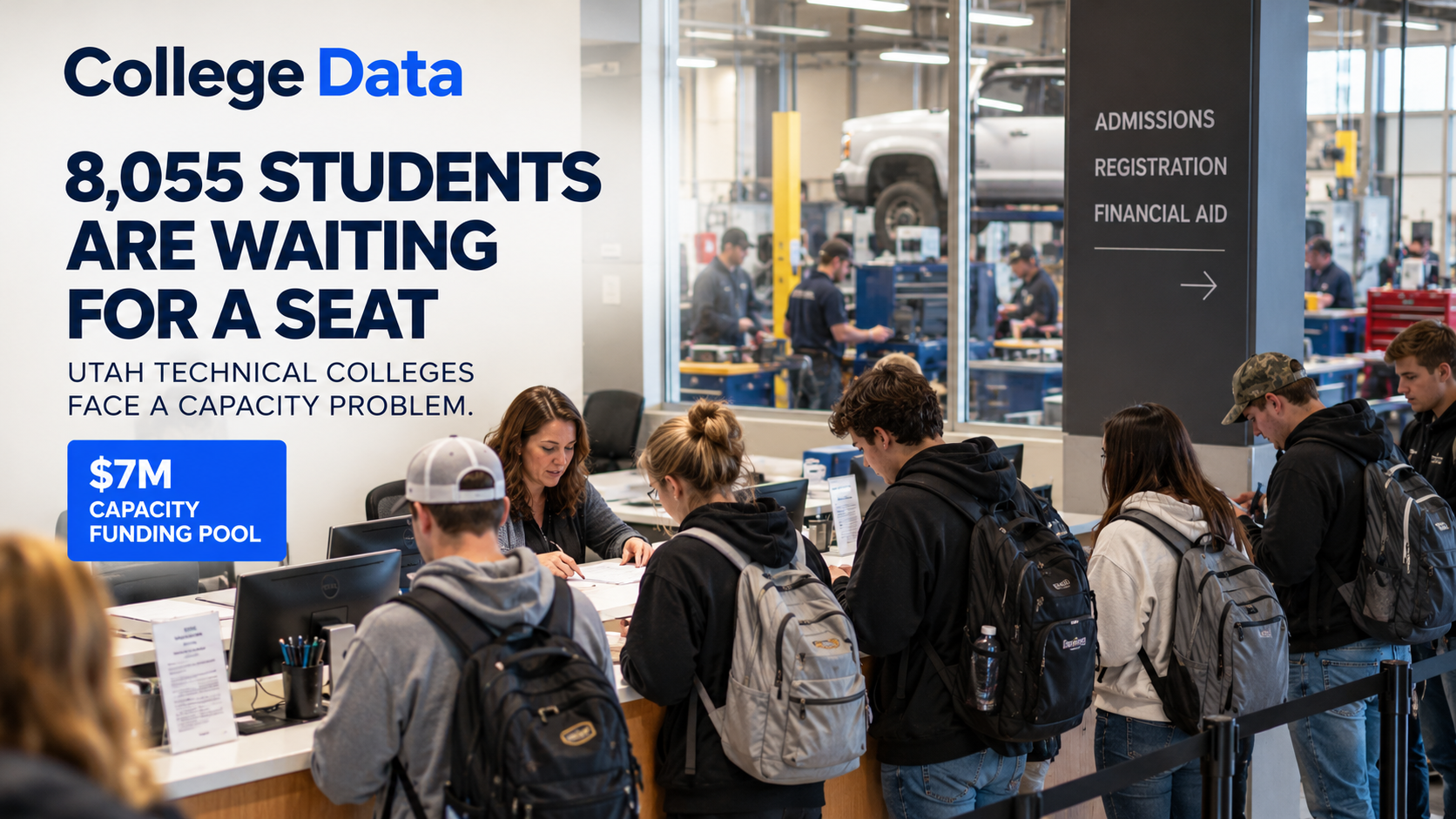
Utah's first official technical college waitlist count found 8,055 people waiting for a seat. Here is what it reveals about career education demand and capacity-based funding.
More Than 8,000 Students Are Waitlisted at Utah Technical Colleges, and It Shows Where Career Education Demand Is Heading
Utah counted its technical college waitlists for the first time: 8,055 people, including 2,421 high schoolers. The number points to a strong appetite for short, affordable career programs and a funding model that is starting to catch up.
Key Takeaways
• Utah's Board of Higher Education released its first official technical college waitlist count: 8,055 people, including 5,634 adults and 2,421 high school students.
• The count equals 2,244 full-time-equivalent students, because many applicants want only a class or two.
• Technical college enrollment was 40,914 last year, up only a few hundred annually over five years, while traditional colleges added nearly 20,000 students in four years.
• A new law, SB216, creates capacity-based funding with a $7 million pool this year, and the board is reallocating 5 percent of instructional funds toward high-demand programs.
A Number Nobody Had Counted Before
Waitlists are the quiet signal of demand in higher education, and most systems do not track them well. Utah just did. The Utah Board of Higher Education released its first official count of students waiting for spots in the state's technical colleges, and the Salt Lake Tribune reported it on October 6, 2026: 8,055 people, made up of 5,634 adults and 2,421 high school students.
The system's chief financial officer, deputy commissioner Nate Talley, converted the headcount into 2,244 full-time-equivalent students, a more conservative measure, since many applicants want only a class or two. Davis Technical College in Kaysville reported the largest numbers, with 2,520 adults and 1,041 high schoolers on its list. One campus, Uintah Basin Technical College in Vernal, does not track its waitlist at all. The count is a first step, and it already tells a clear story.
Waitlists are the quiet signal of demand. Utah just counted its own for the first time.
Why Technical Colleges Are Filling Up
Utah's technical colleges teach short, specialized programs in fields such as automotive repair, firefighting, and plumbing, and they are among the lowest-cost options in higher education. Tuition is charged by the credit hour, from $85 at the low end to $125 at the high end, and a full-time load averages about $2,500 a year, roughly half the lowest tuition at a traditional college or university in the state.
Low cost, short duration, and a direct line to employment make a persuasive combination for adults changing careers and for high school students who want a credential before graduation. The fact that more than 2,400 of the waitlisted students are still in high school is worth underlining. They are the pipeline arriving early, which is an encouraging sign for any state building a skilled workforce.
Capacity, Not Interest, Is the Constraint
The most revealing figure is not the waitlist. It is the enrollment trend beside it. Utah's technical colleges enrolled 40,914 students last year, and over the past five years they have added only a few hundred students annually. Meanwhile, traditional colleges and universities in the state enrolled 218,741 students last fall, up nearly 20,000 from four years earlier.
Technical colleges collect less in tuition and fees and receive less state money per student, which limits spending on buildings, equipment, and instructors. One college president told the Legislature his campus had no more desks, even though it was already offering classes around the clock. When students are lining up and rooms are full, the limiting factor is clearly physical and financial capacity, not demand.
How Utah Is Responding
The state has already started moving. This year's SB216 requires the Board of Higher Education to standardize how technical colleges track waitlists, so the numbers are comparable from campus to campus. It also creates a capacity-based funding calculation, with a pool of $7 million for the current year. Talley estimates more than 60 percent of programs at each technical college would qualify for support.
The board is also pulling another lever. Under a framework adopted in March 2026, each technical college reallocates 5 percent of its instructional appropriations toward high-demand, high-wage programs. Plans reviewed in September direct roughly 90 percent of the reinvestment, more than $4.3 million, straight into instruction, a net increase of over $1 million for classrooms and labs. Priority areas include technology programs adapting to artificial intelligence, trades that support affordable housing such as electrical, plumbing, HVAC, and construction, and occupations of strategic importance such as firefighters and emergency medical technicians in rural Utah.
Tuition is a smaller part of the plan. The board allowed technical colleges to propose increases of up to 6.2 percent starting next fall. If every campus took the maximum, the system would gain about $1.4 million. Talley cautioned that relying only on tuition could lead to arguably outsized increases that still might not be enough, which is why the capacity-based funding formula matters.
A National Pattern Worth Watching
Utah is not alone. Across the country, demand for short-term, career-aligned programs is rising, and federal policy is leaning into it. The Education Department has issued a final rule for the new Workforce Pell program, and a Progressive Policy Institute analysis argues the program could reach nearly 200,000 students but that schools cannot deliver it alone. Capacity, in other words, is the common challenge, and states that find ways to measure it and fund it will be better positioned.
Higher education is also experimenting with the shape of the credential itself. Arizona State's new three-year teacher degree, which K12 Talent covered in detail, shows how institutions are compressing programs to cut cost and time. Technical colleges, with their short, focused programs, have been doing that all along.
Why Admissions and Enrollment Teams Should Care
A waitlist is more than an administrative inconvenience. Students who cannot get in may enroll elsewhere, delay, or abandon the plan. Enrollment management teams that can track demand by program, communicate clearly about timing, and connect waitlisted students to alternatives or earlier starts retain more of that interest. The new Utah standard for tracking waitlists is a model worth copying, since a college cannot manage what it does not measure.
The high school group deserves special attention. Concurrent enrollment and early college programs connect K-12 and higher education, and the students on these lists are often the ones who benefit most from them. The K-12 side is moving, too, with promising signs in early academics such as the sizable reading gains in new NWEA data, discussed in this K12 Data analysis. Strong early learning feeds the pipeline that technical colleges and universities both depend on.
Who Makes the Capacity Decision
Capacity decisions at a technical college involve several desks. Presidents and chief financial officers set budgets. Workforce development directors and career and technical education deans decide which programs to expand. Institutional research directors supply the data that shows where demand is greatest. Enrollment management leaders run the waitlists and the communications. At state level, boards of higher education set the funding rules, as Utah's board has done.
That is a committee spread across campus and system office, and it is the audience for any company that sells equipment, simulation tools, learning management systems, scheduling software, instructor training, or student recruitment services into career education. Waitlist data gives those decision-makers a clear reason to act, and a clear budget conversation to join. College Data's FAQ explains how its lists work if you are mapping a buying team.
Lessons for Community Colleges and Universities
Technical colleges are not the only institutions that can learn from a waitlist. Community colleges often face oversubscribed programs in nursing, allied health, and skilled trades, where clinical sites, lab stations, and qualified instructors set a hard ceiling. Four-year institutions see similar pressure in high-demand majors. A consistent way to count waiting students, by program and by term, is the first step toward making the case for new seats.
The Utah approach also shows the value of separating headcount from full-time equivalence. A raw waitlist can overstate demand when many applicants want a single class, while a full-time-equivalent figure can understate interest in short credentials. Presenting both numbers lets leaders tell an accurate story to legislators, trustees, and employers.
What Employers and Workforce Boards Can Add
Waitlists are also a conversation starter with local employers. A firm that cannot hire enough electricians, technicians, or emergency medical staff has a direct stake in the seats a college can offer. Colleges that bring employers into program planning can sometimes secure donated equipment, adjunct instructors from industry, or shared training space, all of which raise capacity without waiting for a new building.
Workforce development boards can help by sharing hiring projections and by funding short-term pathways. When a college, an employer group, and a workforce board agree on the same priority list, the case for investment is stronger and the results are easier to measure.
Questions Presidents and Trustees Are Asking
Waitlist numbers tend to reach trustees as a single headline, and the follow-up questions come quickly. Which programs have the longest lines? How many seats would a new instructor open? What does a lab cost to build, and what does it cost to staff? Which employers will hire the graduates? Can we serve more students through evening, weekend, or hybrid schedules before we add square footage?
Colleges that can answer those questions with data have a stronger position in budget hearings. Those that cannot often find themselves explaining why demand is high but funding is flat. Tools that track waitlists, forecast demand, and model the cost of added seats are therefore becoming part of the core administrative toolkit.
Early Signals for the Year Ahead
Several developments are worth watching over the coming months: the first full cycle of standardized waitlist reporting in Utah, how many programs qualify for the capacity-based funding pool, the tuition decisions each campus makes, and whether other states adopt similar counting rules. Each will shape how career education demand is understood, and how much room colleges have to grow.
What Vendors and Partners Should Do Next
The strongest outreach connects to the funding moment. Utah has a new capacity-based funding pool, a reinvestment framework with defined priorities, and a state-mandated way to count demand. Vendors whose products help a college serve more students with the same space, such as scheduling and room-utilization tools, blended and online delivery, simulation labs, or accelerated instructor onboarding, can speak directly to the problem. Other states considering similar approaches will look to Utah's results.
College Data maintains college email lists, a higher education contact list, and university mailing lists built around the buying committee, including a technical college president email list, a community college president email list, a workforce development director email list, a career and technical education dean email list, a provost email list, an institutional research director email list, and an enrollment management email list. These are the higher ed decision makers who will shape capacity this year. If you are ready to buy college email list data, or want a higher education marketing database filtered by role and institution type, build your list here and reach them while funding plans are taking shape.
Frequently Asked Questions
How many students are on waitlists at Utah technical colleges?
The Utah Board of Higher Education's first official count found 8,055 people on waitlists, including 5,634 adults and 2,421 high school students, equal to 2,244 full-time-equivalent students.
Why are technical colleges turning students away?
Capacity is the constraint. Utah's technical colleges collect less in tuition and state funding, enrollment grew only a few hundred students a year over five years, and one president told lawmakers his campus had no more desks.
What is capacity-based funding for technical colleges?
Utah's SB216 creates a funding calculation based on program capacity, with a $7 million pool this year, and requires colleges to track waitlists in a standard way. An estimated 60 percent of programs at each college would qualify.