
 0
There are 0 items in your cart: Cart Subtotal: $ 0.00
When AI Becomes a Student's Confidant, Colleges Can Make Human Help as Easy as a Text Message and Build Connection Before Students Need It

 The University Marketplace
 0
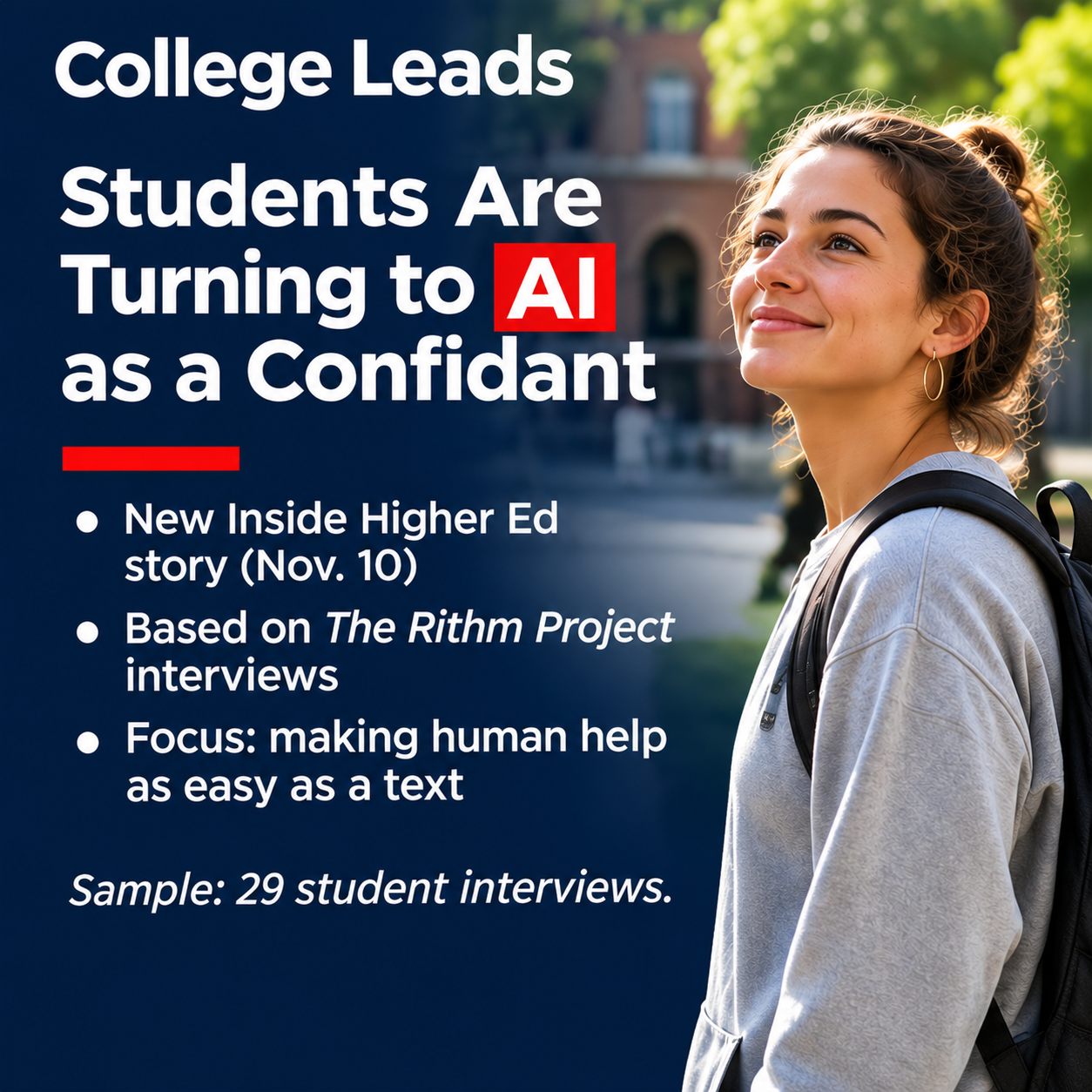
Inside Higher Ed reports new interviews on students using AI as a confidant. See the findings, the caveats, and how colleges can make human help easier to reach than a chatbot.
When AI Becomes a Student's Confidant, Colleges Can Make Human Help as Easy as a Text Message and Build Connection Before Students Need It
New interviews from The Rithm Project show students turning to AI after a conflict, not out of general loneliness. The lesson for campuses is to make people easier to reach than a chatbot.
Key Takeaways
- Inside Higher Ed reported on November 10 that The Rithm Project interviewed 29 young people, 19 of them in or past college, about turning to AI for emotional support, following an earlier survey of nearly 2,400 people ages 13 to 24.
- Almost all interviewees turned to AI after a specific interpersonal problem such as a conflict with a friend or partner, not out of general loneliness, and many saw AI as less risky than confiding in people.
- Alison Lee of The Rithm Project said the concern is when AI becomes a student's only source of emotional support, and recommended making campus help-seeking as easy as texting and widening students' networks of support.
- The interviews are a small qualitative sample that produced themes and not statistics, and a separate Elon University poll of adult AI users found 59 percent would rather talk with friends and family than AI.
A Confidant With No Office Hours
Colleges spend a great deal to build counseling centers, advising offices, residence life teams, and peer networks. A growing number of students are also confiding in a chatbot that is available at 2 a.m. and never has a waiting list. Inside Higher Ed's Joshua Bay reported on November 10 on new research that tries to understand why, and what campuses should do about it.
The research comes from The Rithm Project. It earlier surveyed nearly 2,400 young people ages 13 to 24, including more than 500 young adults ages 18 to 24, about how AI use relates to their social lives and well-being. In November it interviewed 29 of them, 19 of whom were currently enrolled in college or had completed a bachelor's or associate degree. The interviews focused on two groups: students who turn to AI for emotional support and those who interact with AI characters or personas.
A student does not turn to a chatbot because the counseling center is bad. They turn to it because texting is easy and talking is hard.
What the Interviews Found
The researchers describe four themes. First, almost all interviewees turned to AI after a specific interpersonal problem, such as a conflict with a friend or romantic partner, not out of general loneliness. Second, participants saw AI as less risky than confiding in people. They accepted its flaws, such as bias and excessive validation, as more manageable than judgment, gossip, or emotional reactions, and many hid their AI use from others. Third, AI could act as a bridge, helping a student consider another perspective or prepare for a hard conversation, or as a wedge, validating existing views and reinforcing conflict. Fourth, students who recognized AI's risks were more likely to set boundaries or ask it to challenge their assumptions, though awareness alone did not always change behavior.
Alison Lee, the project's head of research and development, said the concern arises when AI becomes a student's only source of emotional support. Whether it strengthens or weakens relationships, she said, depends on the questions students ask, whether they seek understanding or only affirmation, and on whether they have real people to turn to. She noted that chatting with AI feels like texting, the way this generation already talks with close friends.
Read the Research With Care
The sample is small. Twenty-nine interviews produce themes, not statistics, and the themes are the researchers' own interpretation. The article does not report demographic details beyond college status and gives only the sample size of the earlier survey, not its results. All expert commentary comes from a researcher at the organization that conducted the work. Colleges should treat this as a useful window into student thinking, not as proof of how many students behave this way.
A Wider Look: What Adults Say
A separate poll adds context, though it is not about college students. Elon University's Imagining the Digital Future Center, working with YouGov, surveyed 4,268 U.S. adult internet users in May and found that 27 percent qualify as AI companion users. Among those users, 31 percent call their chatbot a friend and 50 percent use it to talk through personal problems. Asked whether they would rather converse with AI or with friends and family, 59 percent chose friends and family and 11 percent chose AI. About 74 percent predicted that AI will increase social isolation and loneliness. The sample is an online panel of self-reported users, not a probability sample, and the report does not break out college-age respondents.
Taken together, the picture is not students abandoning people for machines. It is students using a tool for what feels safe, and sensing, as many adults do, that it is no substitute for the real thing.
A Voice From the Field: Tom Murphy and Sweethearts & Heroes
Tom Murphy, the founder of Sweethearts & Heroes, has spent years working with young people on the idea that no one should face a hard moment alone. A former All-American wrestler and UFC competitor, Murphy turned from a corporate career to full-time youth advocacy. The organization he started in 2006 with co-founder Rick Yarosh teaches the message of H.O.P.E., which stands for Hold On, Possibilities Exist, and promotes action. Per its About page, its focus is to “educate society on the impact of hopelessness, build empathy and compassion in our youth.”
Its core programs, as its site lists them, are school assemblies, circles, and youth leadership, so campuses should not assume a direct fit. But the principle travels well to college: connection works best when someone takes action. The Rithm Project's finding that students turn to AI after a specific conflict suggests a practical use of that idea. Students who know how to have a hard conversation, and who have friends trained to listen, need the chatbot less. Campuses should ask for evidence before adopting any outside program.
The most protective feature on any campus is a friend who notices when you stop showing up.
What Colleges Can Do
The researchers' recommendations are practical. Identify where students naturally turn during emotional difficulties. Widen students' networks of support so more people feel comfortable reaching out regularly. Make help-seeking through campus services as easy as texting or direct messaging. Help students recognize the rewards of human connection, not only the risks of AI. And frame AI use as a risk-and-reward decision, not something to fully embrace or ban.
Each can become a project. Counseling and advising offices can offer text-based scheduling and quick check-ins. Residence life can train resident assistants to notice and respond to conflict. Student engagement can fund peer listening programs and low-pressure social events. Orientation can include a short session on using AI thoughtfully, including asking it to challenge assumptions, not simply agree.
Lower the Barrier to a Person
Many campus services still require a form, a phone call, or a long wait. A student in the middle of a roommate conflict is unlikely to jump through those hoops. Colleges can audit the path from the moment a student needs help to the moment a person responds. How many steps does it take? How long is the wait? Can a student start with a text? A shorter path is not a luxury. It is the competition.
Retention Is Relationship
Student success leaders often point to belonging as a driver of persistence. The same relationships that help a student through a conflict help them through a hard semester. Advisors who know a student's name, faculty who notice a missing assignment, and peers who check in are the people who keep students enrolled. In our earlier look at waitlists at Utah technical colleges, demand for programs that connect students to careers was strong, and the colleges that serve those students well pair programs with support.
Who Needs to Be in the Room
This work crosses the institution. The vice president for student affairs and the dean of students set priorities. The director of counseling services and the director of academic advising lead support. The director of student success tracks outcomes. The director of residence life and the director of student engagement shape daily community. The chief information officer reviews AI tools and data practices.
Questions Trustees Will Ask
Trustees who read about student AI use will ask direct questions. What are we hearing from our own students? How easy is it to reach a person here, and how long does it take? What AI tools do we provide or endorse, and who reviewed them? How are we measuring belonging and retention? What are we doing for students who are alone? Leaders who answer with current figures show that the campus is paying attention.
Peer Support Scales
Professional counselors are scarce and expensive, and no campus will staff its way to every conversation. Peer programs help fill the gap. Trained student listeners, peer mentors in first-year courses, and resident assistants who know how to start a difficult conversation extend a campus's reach into places counselors cannot go. They also build the habit the researchers point toward: having several people a student feels comfortable contacting.
Training matters. Peers need clear guidance on when to listen and when to connect a student with a professional, and they need support of their own. Done well, these programs help the helpers too, since students who learn to support others often build their own sense of belonging.
Teach Students to Use AI Wisely
The interviews offer a hopeful detail. Students who recognized AI's risks were more likely to set boundaries or ask the tool to challenge their assumptions. That is a teachable skill. A short module in orientation or a first-year seminar can show students how to ask an AI to present the other side of an argument, prepare for a difficult conversation, or point toward a real person. It can also explain how these tools can flatter users and why that matters.
Colleges that provide or endorse AI tools should review them for privacy, data retention, and what happens when a student describes a crisis. Students may share very personal information with a chatbot without reading the terms, and the institution is better placed to ask the hard questions than the student is.
Do Not Forget Commuter and Online Students
Many of the students who need connection most do not live on campus. Commuters, working adults, and online learners often have fewer chances to meet people by accident. Colleges serving them can create virtual drop-in hours, text-based advising, small cohort groups, and regular outreach from a named person. A student who never sets foot in a residence hall can still have someone who knows their name.
Signals to Watch
Several developments are worth following: the full Rithm Project report, larger studies of AI use by college students, campus policies on AI and well-being, whether counseling and advising offices adopt text-based access, and any research connecting AI companion use to persistence. Each will show how campuses balance new tools with the relationships students need.
College Leads maintains college email lists, a higher education contact list, and university mailing lists built around the student support buying committee, including a vice president for student affairs email list, a dean of students email list, a director of counseling services email list, a director of student success email list, a chief information officer email list, a director of academic advising email list, a director of residence life email list, and a director of student engagement email list. These are the higher ed decision makers shaping how colleges support students in the age of AI. If you are ready to buy college email list data, or want a higher education marketing database by role and institution type, build your list here while campuses plan spring student support.
Frequently Asked Questions
Are college students using AI for emotional support?
Some are. The Rithm Project interviewed 29 young people, 19 of them in or past college, who turned to AI for emotional support, usually after a specific conflict with a friend or partner. It is a small qualitative sample, so it shows themes, not rates.
How can colleges make help-seeking easier?
The researchers recommend making campus help-seeking as easy as texting or direct messaging, widening students' support networks, and helping students see the rewards of human connection, not only the risks of AI.
Who leads student support at a college?
The vice president for student affairs and the dean of students set priorities, with counseling, advising, student success, residence life, and student engagement leaders carrying out the work and the chief information officer reviewing AI tools.